
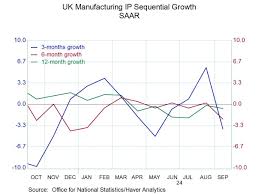

UK manufacturing output declined for the third consecutive month in March, according to data from the Office for National Statistics released on Thursday, with the sector contracting by 0.4% compared to February as export orders weakened and domestic demand remained subdued. The figures underscore the divergence within the UK economy between a resilient services sector and a manufacturing base that continues to struggle with a combination of elevated input costs, sterling strength and the impact of US and EU trade tariffs on key export markets.
The automotive sector recorded the sharpest decline, with output falling 2.1% in March as car manufacturers reduced production schedules in response to weaker demand from European markets and uncertainty about the US tariff situation. The Stellantis plant in Ellesmere Port, which manufactures electric vehicles for both domestic and European markets, operated at approximately 75% capacity during March, down from over 90% in the same month last year.
The Make UK industry body, which represents British manufacturers, said the data was “deeply concerning” and called on the government to provide a comprehensive industrial strategy with clear long-term commitments on energy costs, trade policy and workforce development. Chief executive Stephen Phipson argued that manufacturing was being disproportionately affected by the combination of higher employer National Insurance contributions and the uncertainty created by the global trade environment.
Not all sub-sectors performed poorly. Pharmaceutical manufacturing, where the UK has significant global strengths, increased output by 1.8% in March, supported by strong export demand from Asia and the Middle East. Aerospace components also performed relatively well, benefiting from the surge in commercial aircraft orders discussed elsewhere in today’s edition. Food and beverage manufacturing was broadly flat, reflecting a combination of stable domestic demand and some recovery in export volumes to EU markets.
The Manufacturing Purchasing Managers’ Index for April, published separately by S&P Global, came in at 48.2 — below the 50 threshold that separates expansion from contraction for the fifth consecutive month. Survey respondents cited new export order weakness as the primary driver of the decline, with companies noting particular softness in orders from Germany, France and the United States.
The Bank of England’s regional agents, whose reports feed into the Monetary Policy Committee’s deliberations, noted in their latest assessment that manufacturers in the Midlands and North were “markedly more pessimistic” about the near-term outlook than their counterparts in the services sector, a divergence that is likely to feature prominently in the May MPC meeting discussions.
— Sarah Mitchell, London Capital Post